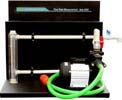
Mô tả Sản phẩm
Nền tảng đào tạo khí nén Nvis 3020 khám phá các sinh viên và các chuyên gia trong ngành về các nguyên tắc của khí nén và các thiết bị khí nén. Nó cho biết, làm thế nào các thành phần quản lý, chỉ huy, chỉ đạo hoặc điều tiết bằng khí nén. Tất cả các loại điều khiển khí nén được giải thích trong Nền tảng.
Nền tảng đào tạo khí nén Nvis 3020 có các thành phần khí nén có thể được sử dụng để nghiên cứu về Pneumatics. Có một loạt các thử nghiệm có thể được thực hiện trên Nền tảng.
Tính năng sản phẩm
Chức năng và nhận dạng các thành phần khí nén và ký hiệu của chúng
Rèn luyện kỹ năng xử lý sự cố
Thiết kế nhỏ gọn để bàn
Chi tiết thử nghiệm đã sẵn sàng
Xây dựng mạnh mẽ
Van điện từ 3/2, Nút ấn 3/2 (Thiết bị truyền động Palm), Van tay đòn 5/2, Van điều chỉnh lưu lượng, Đồng hồ đo áp suất, Bộ bôi trơn điều chỉnh bộ lọc (FRL), Manifold, Xi lanh tác động kép (DAC), Xi lanh tác động đơn ( SAC)
Bảng điều khiển cho các thành phần khí nén
Điều khiển khí nén tuần tự & tuyến tính
Hiểu biết về các thành phần khí nén công nghiệp
Tài liệu khóa học đầy đủ & tài liệu tham khảo
Push Một chạm trong phụ kiện ‘để dễ dàng lắp ống PU – được cung cấp cho kết nối nhanh và chống rò rỉ
Phạm vi học tập
Hoạt động của một xi lanh diễn xuất duy nhất
Hoạt động của một xi lanh tác động kép
Chuyển động pít-tông của một xi lanh diễn xuất đơn bằng tay
sử dụng nút ấn
Điều khiển bằng tay chuyển động piston của xi lanh tác động kép
Điều khiển thí điểm một chuyển động piston xi lanh diễn xuất duy nhất
Điều khiển thí điểm một chuyển động piston xi lanh đôi diễn xuất
Điều khiển trình tự thủ công (A + A-) của xi lanh tác động kép
Điều khiển trình tự thủ công (+ A + B-A-B) của xi lanh tác động kép
Điều khiển trình tự thủ công (+ A-B + A-B) của xi lanh tác động kép
Điều khiển trình tự thủ công (-A + B + A-B) của tác động kép
hình trụ
Điều khiển trình tự thủ công (-A-B + A + B) của tác động kép
hình trụ
Trình tự kết hợp của một xi lanh tác động đơn và một
Xy lanh tác động kép bằng cách sử dụng van điện từ 3/2
Trình tự kết hợp của một xi lanh tác động đơn và một
Xy lanh tác động kép bằng cách sử dụng van tay đòn 3/2 & 5/2
Product Description
Nvis 3020 Pneumatic Training Platform explores students & industry professionals to the principles of pneumatics and compressed air devices. It tells, how components manage, command, direct or regulates pneumatically. All types of pneumatic controls are explained in the Platform.
Nvis 3020 Pneumatic Training Platform has pneumatic components which can be used for the study of Pneumatics. There is a wide range of experiments which can be performed on the Platform.
Product Features
- Function and identification of Pneumatic components and their symbols
- Practice troubleshooting skills
- Compact tabletop ergonomic design
- Ready experimental details
- Robust construction
- 3/2 Solenoid Valve, 3/2 Push button (Palm Actuator), 5/2 Hand lever Valve, Flow Control Valve, Pressure Gauge , Filter Regulator Lubricator (FRL), Manifold, Double Acting Cylinder (DAC), Single Acting Cylinder (SAC)
- Mounting panel for Pneumatic Components
- Sequential & Linear Pneumatic Control
- Understanding of Industrial Pneumatic Components
- Exhaustive course material & references
- ‘One Touch Push in Fittings’ for easy fitting of PU tubes – which are provided for fast & leak-proof connection
Scope of Learning
- Operation of a Single Acting cylinder
- Operation of a Double Acting cylinder
- Piston movement of a Single Acting cylinder manually by
- using Push button
- Manual control of piston movement of double acting cylinder
- Pilot control of a Single Acting cylinder piston movement
- Pilot control of a Double Acting cylinder piston movement
- Manual sequencing control (A+A-) of double acting cylinder
- Manual sequencing control (+A+B-A-B) of double acting cylinder
- Manual sequencing control (+A-B+A-B) of double acting cylinder
- Manual sequencing control (-A+B+A-B) of double acting
- cylinder
- Manual sequencing control (-A-B+A+B) of double acting
- cylinder
- Combined sequencing of a Single acting cylinder and a
- Double acting cylinder by using 3/2 solenoid valve
- Combined sequencing of a Single acting cylinder and a
- Double acting cylinder by using 3/2 & 5/2 Hand Lever valve




![[IMG]](https://toantamtech.com/wp-content/themes/ktech_hdx/img/b-1.png)
![[IMG]](https://toantamtech.com/wp-content/themes/ktech_hdx/img/b-2.png)
![[IMG]](https://toantamtech.com/wp-content/themes/ktech_hdx/img/b-3.png)
![[IMG]](https://toantamtech.com/wp-content/themes/ktech_hdx/img/b-4.png)
![[IMG]](https://toantamtech.com/wp-content/themes/ktech_hdx/img/b-5.png)
![[IMG]](https://toantamtech.com/wp-content/themes/ktech_hdx/img/b-6.png)
![[IMG]](https://toantamtech.com/wp-content/themes/ktech_hdx/img/b-7.png)
![[IMG]](https://toantamtech.com/wp-content/themes/ktech_hdx/img/b-8.png)
![[IMG]](https://toantamtech.com/wp-content/themes/ktech_hdx/img/b-9.png)
![[IMG]](https://toantamtech.com/wp-content/themes/ktech_hdx/img/b-10.png)
![[IMG]](https://toantamtech.com/wp-content/themes/ktech_hdx/img/b-11.png)
![[IMG]](https://toantamtech.com/wp-content/themes/ktech_hdx/img/b-12.png)
![[IMG]](https://toantamtech.com/wp-content/themes/ktech_hdx/img/b-13.png)
![[IMG]](https://toantamtech.com/wp-content/themes/ktech_hdx/img/b-14.png)