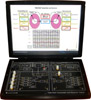
Mô tả Sản phẩm
Scienceech TechBooks là các nền tảng học tập nhỏ gọn và thân thiện với người dùng để cung cấp một cách hiện đại, di động, toàn diện và thiết thực để học Công nghệ. Mỗi TechBook được cung cấp tài liệu học tập Đa phương tiện chi tiết bao gồm lý thuyết cơ bản, từng bước làm thủ tục để tiến hành thử nghiệm và các thông tin hữu ích khác.
Bộ phát và thu TDM-PAM Scienceech TechBook 2152 là một hệ thống liên lạc trong đó tín hiệu tin nhắn được điều chế bằng cách sử dụng Điều chế biên độ xung và nhiều truy cập được cung cấp bằng cách ghép kênh phân chia thời gian. Thông tin tin nhắn được mã hóa theo biên độ của một chuỗi các xung tín hiệu và được truyền bằng cách sử dụng Ghép kênh phân chia thời gian (tức là trong các khe thời gian khác nhau).
TechBook trình bày các chế độ hoạt động sau đây giữa máy phát và máy thu –
Chế độ giao tiếp tín hiệu 1: 3 (Đồng hồ / Đồng bộ hóa / Tín hiệu điều chế)
Chế độ 2: 2 tín hiệu giao tiếp (Tín hiệu đồng bộ / điều chế); Đồng hồ được phục hồi tại máy thu.
Chế độ giao tiếp tín hiệu 3: 1 (Tín hiệu điều chế); Đồng hồ và Đồng bộ hóa được phục hồi tại máy thu
Nhà khoa học 2152, TDM – Máy phát PAM là một trợ giúp giảng dạy lý tưởng để tăng cường giáo dục, đào tạo, kỹ năng và phát triển trong tâm trí trẻ của chúng ta.
Tính năng sản phẩm
Đồng hồ điều khiển pha lê
Bộ tạo tín hiệu tương tự được đồng bộ hóa trên tàu (sóng DC và Sine)
Thể hiện việc lấy mẫu và tái cấu trúc theo tiêu chí Nyquist
Bốn tần số lấy mẫu có thể lựa chọn
Lấy mẫu chu kỳ nhiệm vụ xung có thể lựa chọn
Máy phát xung trên tàu
Bốn kênh đầu vào tương tự để trình diễn TDM-PAM
Tạo đồng hồ tại máy thu bởi PLL
Bộ lọc thứ tư Butterworth Low Pass
Phạm vi học tập
Kỹ thuật điều biến biên độ xung
Ghép kênh và phân chia thời gian
PLL là Hệ số tần số để tạo đồng hồ từ tín hiệu đồng bộ
Ba chế độ hoạt động giữa máy phát và máy thu 4 (3 tín hiệu / 2 tín hiệu / 1 giao tiếp tín hiệu)
Ảnh hưởng của chu kỳ làm việc khác nhau của xung lấy mẫu đối với việc tái tạo tín hiệu 4
Ảnh hưởng của các tần số lấy mẫu khác nhau đến TDM-PAM & kỹ thuật giải điều chế
Product Description
Scientech TechBooks are compact and user friendly learning platforms to provide a modern, portable, comprehensive and practical way to learn Technology. Each TechBook is provided with detailed Multimedia learning material which covers basic theory, step by step procedure to conduct the experiment and other useful information.
TDM-PAM Transmitter and Receiver Scientech TechBook 2152 is a communication system where the message signal is modulated using Pulse Amplitude Modulation and multiple access is provided using Time Division Multiplexing. The message information is encoded in the amplitude of a series of signal pulses and transmitted using Time Division Multiplexing (i.e. in different time slots).
The TechBook demonstrates following modes of operation between transmitter and receiver –
Mode 1: 3 signals communication (Clock/Sync/Modulated Signals)
Mode 2: 2 signals communication (Sync/Modulated signals); Clock is recovered at receiver.
Mode 3: 1 signal communication (Modulated signal); Clock and Sync are recovered at receiver
Scientech 2152, TDM – PAM Transmitter Receiver is an ideal teaching aid to enhance education, training, skills & development amongs our young minds.
Product Features
- Crystal controlled clock
- On-board synchronized analog Signal Generator (DC and Sine wave)
- Demonstrates sampling and reconstructed as per Nyquist criterion
- Four switch selectable sampling frequencies
- Sampling pulse duty-cycle selectable
- On-board Pulse Generator
- Four analog input channels to demonstrate TDM-PAM
- Generation of clock at receiver by PLL
- Fourth order Butterworth Low Pass Filter
Scope of Learning
-
Pulse Amplitude Modulation technique
-
Time Division Multiplexing and Demultiplexing
-
PLL as Frequency Multiplier to generate clock from sync signal
-
Three modes of operation between transmitter and receiver 4 (3 signals/ 2 signals/ 1 signal communication)
-
Effect of varying duty cycle of sampling pulse on signal 4 reconstruction
-
Effect of different sampling frequencies on TDM-PAM & demodulation technique



![[IMG]](https://toantamtech.com/wp-content/themes/ktech_hdx/img/b-1.png)
![[IMG]](https://toantamtech.com/wp-content/themes/ktech_hdx/img/b-2.png)
![[IMG]](https://toantamtech.com/wp-content/themes/ktech_hdx/img/b-3.png)
![[IMG]](https://toantamtech.com/wp-content/themes/ktech_hdx/img/b-4.png)
![[IMG]](https://toantamtech.com/wp-content/themes/ktech_hdx/img/b-5.png)
![[IMG]](https://toantamtech.com/wp-content/themes/ktech_hdx/img/b-6.png)
![[IMG]](https://toantamtech.com/wp-content/themes/ktech_hdx/img/b-7.png)
![[IMG]](https://toantamtech.com/wp-content/themes/ktech_hdx/img/b-8.png)
![[IMG]](https://toantamtech.com/wp-content/themes/ktech_hdx/img/b-9.png)
![[IMG]](https://toantamtech.com/wp-content/themes/ktech_hdx/img/b-10.png)
![[IMG]](https://toantamtech.com/wp-content/themes/ktech_hdx/img/b-11.png)
![[IMG]](https://toantamtech.com/wp-content/themes/ktech_hdx/img/b-12.png)
![[IMG]](https://toantamtech.com/wp-content/themes/ktech_hdx/img/b-13.png)
![[IMG]](https://toantamtech.com/wp-content/themes/ktech_hdx/img/b-14.png)